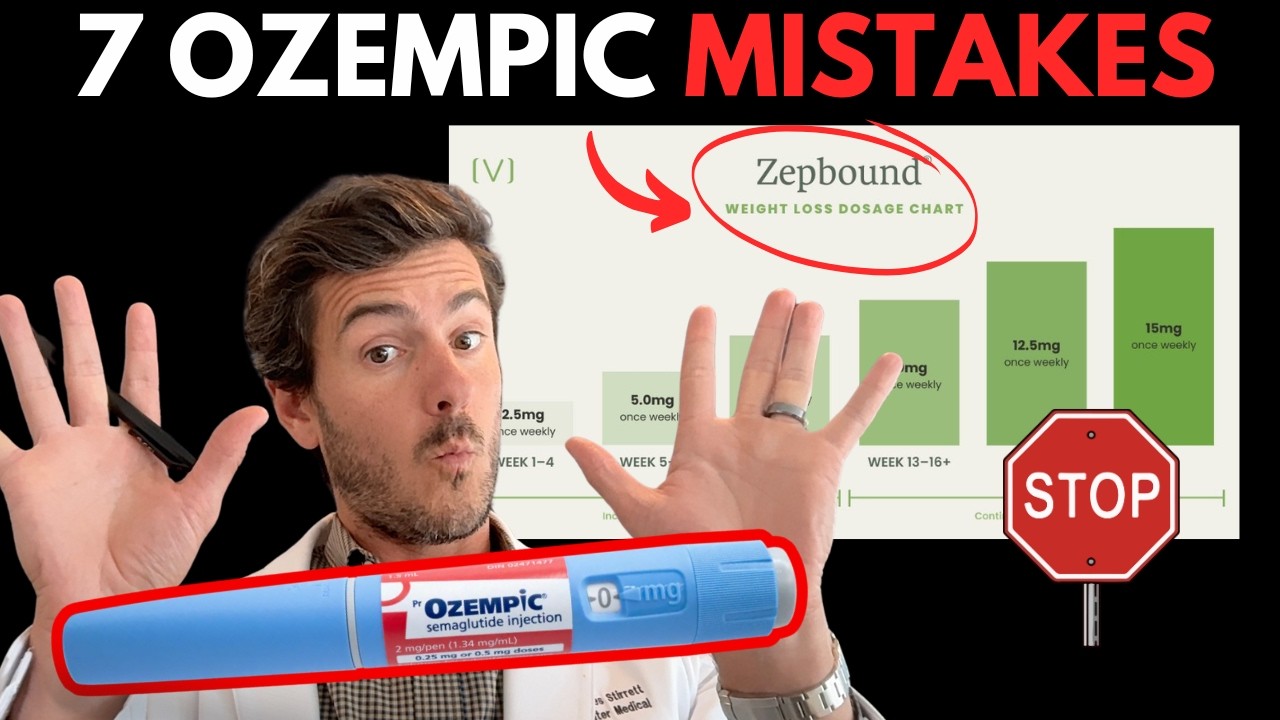
The scale has been stuck for two weeks. Your first thought: I need a higher dose. That's what most people think when weight loss slows on a GLP-1. And it's exactly the mistake that sends them spiraling into side effects, stalled progress, and the assumption that the medication stopped working.
Dr. James Stirrett sees it constantly in his functional medicine practice. He works with GLP-1 patients all day, and he says the people who struggle aren't failing because of the drug. They're doing normal things, things their doctors never warned them about, that make nausea worse, constipation unbearable, and fat loss grind to a halt.
He's laid out seven things never to do if you want real results, fewer side effects, and a shot at keeping the weight off long term. The sixth one, he says, stalls out half the people who walk through his door.
1. Do not chase the dose when the scale stalls
This is the number one beginner mistake. The scale slows, so you immediately think you need more medication. But chasing dosage is how people spiral.
You increase too quickly. Side effects like constipation and nausea kick in. You're eating too few calories because your appetite is crushed. Protein drops. You don't have the energy to exercise. You feel inflamed and yucky. And on top of all that, you're still not losing weight.
Stirrett's rule: do not chase the dose. Chase the response.
He tracks four things with every beginner. Hunger and cravings: is the food noise turning down? Energy levels: do you feel depleted or functional? Protein intake: are you eating enough to protect muscle? Bowel movements: one to two well-formed stools a day, not less.
If hunger is improved but you're constipated, exhausted, and not eating enough protein, it may not be worth staying at that dose. The goal is momentum, not misery.
Do not chase the dose. Chase the response of the medication.Dr. Stirrett
Why this matters if you haven’t started yet: If you're thinking about starting, know this: higher doses do not guarantee more weight loss. They do guarantee more receptor stimulation, which means more side effects.
2. Do not let your medication spike and crash every week
Most doctors follow the standard prescribing chart. Every month, double the dose. Month one, month two, month three, boom, boom, boom. Stirrett says he simply disagrees with it.
Doubling the dose doesn't mean you'll lose twice as much weight. But it does mean your receptor stimulation doubles, so your chances of nausea and constipation go up exponentially. Meanwhile, weight loss improvements are not proportional.
He sees people stuck at 5 mg jump to 7.5 mg. They lose another pound or two, then the body adjusts. The same thing holding them back at five is now holding them back at 7.5.
He showed a graph comparing injecting every seven days versus every four days. With weekly injections, semaglutide blood levels spike high, then dip hard by day six or seven. That's when the food noise comes roaring back and people feel like the medication isn't working.
Injecting every four days keeps the curve tighter. You still have a spike and a trough, but the swings are smaller. Less time spent at low levels. The medication naturally builds up in your system over three weeks without you increasing the dose at all.
What he sees clinically: less side effects, better hunger control, less need to keep increasing. People lose weight, feel good, and don't get stuck in the double-the-dose trap.
Just because you increase the dosage doesn't mean you're going to lose more weight. But what you can guarantee is that the receptor stimulation will be double.Dr. Stirrett
Why this matters if you haven’t started yet: Micro-dosing, injecting smaller amounts more frequently, can keep blood levels steady and avoid the weekly crash that makes you think you need more.
3. Never let protein become optional
Stirrett spoke with someone this morning who said they were doing great, cleaning up their diet, eating oatmeal for breakfast. His response: that's fine, but if there's no protein with it, there's nothing to balance blood sugar.
If you want to look better, feel better, and keep results long term, protein is non-negotiable. On a GLP-1, you can lose weight fast. You do not want muscle going with it. That's how you end up softer, weaker, more fatigued, and plateauing sooner.
His beginner rule: eat every three to four hours and get 30 grams of protein at every meal. It's a surefire way to balance blood sugar and make sure you're losing weight.
Beginner-friendly ways to increase protein: quality protein shakes (he's not a fan of whey, prefers beef protein isolate, uses Equip chocolate flavor), eggs if you tolerate them, chicken, turkey, steak, ground beef, and protein-rich soups with bone broth, sautéed vegetables, and ground meat. Easy fiber and protein in one bowl.
4. Do not cheat the day after your shot
Everyone has cheat days or cheat moments. But don't do it the day after your injection, especially if you're beyond a starting dose.
You're opening the door for nausea and other side effects. Stirrett sees people stall out faster when they eat bar food, fried foods, chicken wings, large portions, sugary desserts, or alcohol the day or two after their shot.
These foods don't sit well with a GLP-1, and timing matters.
5. Hydration is not just water. You need minerals.
Probably 80% of the people Stirrett works with come in and this is something they have to focus on. Hydration doesn't just equal the amount of water you drink. It's the amount of water and minerals you retain.
If you're used to drinking 20 ounces of water a day and you jump to 100 ounces when you start a GLP-1, you'll temporarily dehydrate yourself even more by flushing minerals out. Constipation becomes a problem really fast.
GLP-1 medications are already a little dehydrating. So when you increase water intake, you need electrolytes.
If he could only choose two or three supplements for someone on a GLP-1, electrolytes would be in the top two or three. He's not a fan of Nuun tablets or even LMNT. He wants professional-grade electrolyte formulas if you're taking them daily.
Why this matters if you haven’t started yet: If you're starting a GLP-1 and planning to increase your water intake, add electrolytes from day one. Don't wait until you feel off.
6. Do not wait until you're constipated to take action
GLP-1 medications slow your digestive system down. If you already struggled with constipation before starting, it's going to get worse. The higher the dose, the worse it gets.
If Stirrett had to name the top things that stall people's progress, constipation would be number one or number two.
If you're just getting started and you know constipation is an issue, focus on three areas. Water: you need enough for stool to pass efficiently through your system, 60 to 80 ounces a day with electrolytes. Fiber: not just any fiber, soluble fiber to add bulk and normalize bowel movements. Psyllium husk or other soluble fibers mixed into water, taken daily. Flora: most people have an imbalance of good versus bad bacteria, so a refrigerated, high-quality, broad-spectrum probiotic helps.
Marry those three together and you should have regular bowel movements. If you don't, find a doctor to help you sort it out.
If you let constipation become severe, it will stall you out extremely quickly. Start early. If you're not having a bowel movement every single day, take action. You need to flush out toxins and broken-down fat cells.
If you had to ask me, what are the top things that stall people's progress, constipation would be number one or number two.Dr. Stirrett
7. Do not skip strength training
Stirrett has seen so many women recently doing running, Pilates, Orange Theory, pushing their cardio hard, and seeing no results whatsoever.
If you're only doing cardio, undereating on protein, and your dosage is too high, the weight you lose is probably muscle. And that's a recipe for plateau.
The only way to lose fat, not muscle, and reverse insulin resistance is to implement strength training. That means lifting something heavier than your body weight. Anytime you load the body heavier than you could make it yourself, that's strength training.
By increasing muscle, you will reverse insulin resistance ten times faster than someone who just does Orange Theory or hits 10,000 steps a day.
The beginner rule: two to three times a week is all you need. If you don't know what you're doing, watch a YouTube video or hire a personal trainer for a handful of sessions to learn the basics. Then you can do it on your own.
Everyone's talking about regaining weight after stopping Ozempic or Wegovy. Stirrett says it's very possible to lose the weight and not gain it back, as long as you're strength training, your insulin resistance is low, and you're eating well. It doesn't have to come roaring back.
By increasing your muscle or implementing strength training, you will reverse your insulin resistance 10 times faster than somebody who just does Orange Theory or just hits their 10,000 steps a day.Dr. Stirrett
Notice what most of these mistakes have in common. They're not about the drug. Not the dose, not the pen, not the brand. They're about what you do around the injection: how you respond to a stall, how you time your meals, whether you're drinking water with minerals or flushing them out, whether you're moving your bowels or letting waste sit for days.
Every one of these seven is fixable before you take your next shot. And every one of them, if left unfixed, will make you think the medication stopped working when the real problem was never the medication at all.
Questions people ask
Should I increase my Ozempic dose if weight loss stalls?
No. Chasing the dose when the scale stalls is the number one beginner mistake. Track hunger, energy, protein intake, and bowel movements instead. If those are off, fix them before increasing.
How often should I inject semaglutide to avoid side effects?
Injecting every four days instead of every seven keeps blood levels steadier, reduces the weekly crash that brings back food noise, and can mean fewer side effects with less need to keep increasing the dose.
What should I do to prevent constipation on a GLP-1?
Drink 60 to 80 ounces of water a day with electrolytes, take soluble fiber like psyllium husk daily, and use a refrigerated broad-spectrum probiotic. Do not wait until you're already constipated.
Dr. James Stirrett runs a functional medicine practice where he works with patients using GLP-1 medications, focusing on dosing strategy, metabolic testing, and long-term weight maintenance. 223,325 views on the original video.
Watch the original on YouTube →