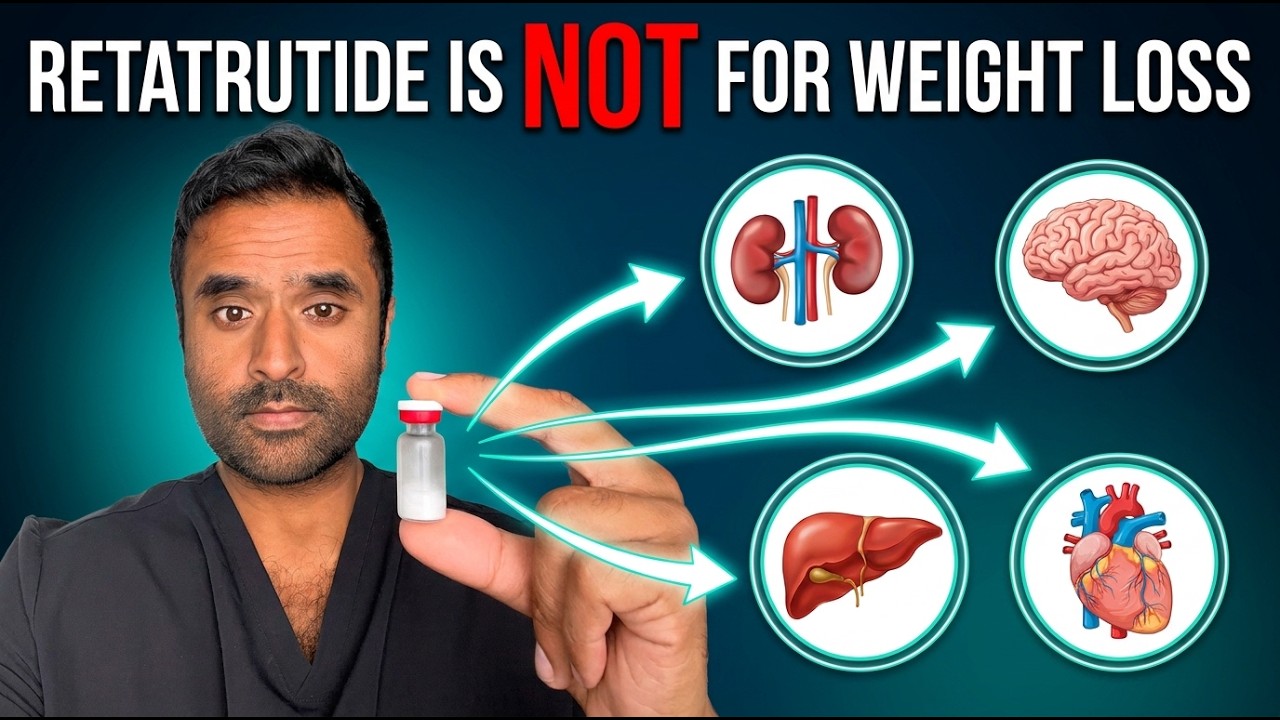
Everywhere you look, people are calling retatrutide the next Ozempic. They are wrong. The weight loss is bigger, yes. But if that is all you are watching, you are missing what this molecule actually does.
In peer-reviewed clinical trials, retatrutide nearly erased fatty liver disease in nine out of 10 patients at the top dose. It cut knee arthritis pain by 75%. It dropped the most dangerous fats in your blood by more than 40%. It may even slow failing kidneys from shutting down completely.
That is not a weight loss drug. That is a disease-modifying therapy that happens to also melt fat. And Dr. Kevin Joseph, a physician who specializes in obesity medicine and peptide therapy, says the difference matters because by the end of the data, the number on the scale might be the least interesting part.
It flips three metabolic switches at once, and the third one rewrites the rules
Retatrutide is a once-weekly injection from Eli Lilly. The official term is triple hormone receptor agonist. In plain English, it turns on three different metabolic switches in your body at the same time, all from a single molecule.
Switch one is GLP-1, the receptor semaglutide and tirzepatide already hit. Switch two is GIP, which tirzepatide added first. Switch three is glucagon, and that is the one doctors used to avoid on purpose.
Here is the twist. On two of those switches, retatrutide is actually weaker than your body's own natural hormones. But on the GIP receptor, it is nearly nine times stronger and it stays in your system for about six days. That is why one shot a week works.
For decades, doctors feared the glucagon switch because glucagon's classic job is to raise blood sugar. It tells your liver to dump stored sugar into your blood. In people with metabolic disease, that sounds like the last thing you want.
But newer research uncovered a plot twist. When you flip the glucagon switch gently and you do it while GLP-1 and GIP are also switched on, it stops being a problem and starts being a metabolic superpower.
The glucagon switch cranks up how many calories your body burns. In clinical trials, retatrutide beat tirzepatide on weight loss and this energy burning effect is exactly the reason why.Dr. Kevin Joseph, DO
Why this matters if you haven’t started yet: This is the part most videos skip. If you do not understand how this drug works, none of the organ data that follows will make sense.
It tells your liver to burn fat, make less fat, and stop storing it in the first place
Put it all together. Activating the GLP-1 receptor leads to less hunger, better insulin, and less liver fat. Activating GIP means more insulin release when blood sugar is high, better fat handling in your fat tissue, and lower inflammation throughout your body. Activating the glucagon receptor means more calories burned, your liver burns fat instead of storing it, and your liver makes less new fat in the first place.
You can see it in the blood. A marker called beta-hydroxybutyrate, which signals fat burning, shoots up in the trials. This is not just a stronger Ozempic. It is a totally different approach, and that is exactly why the results look the way they do.
The weight loss hit 29%, a record, and people were still dropping at 68 weeks
In the phase 2 clinical trials, at 48 weeks, people on the top dose of 12 milligrams a week lost an average of 24% of their body weight. Even at the lower 8 milligram dose, people lost about 22.8%.
To put that in perspective, tirzepatide topped out around 22% and semaglutide around 15% to 17%. Retatrutide was already beating both by a big margin. And at 48 weeks, the weight loss had not even leveled off yet. People were still dropping, and pretty significantly.
In the phase 3 trial called Triumph 4, at 68 weeks, those on 9 milligrams lost about 26% of their body weight. Those on 12 milligrams lost about 29%. That 29% is the biggest weight loss ever reported for any drug in a phase 3 clinical trial, ever. These are numbers doctors used to only see from bariatric surgery, except this came from a shot.
So yes, the weight loss is wild. But if you stop there, you have told maybe 30% of the story. The reason this drug might change medicine is not the scale. It is what it is doing to the organs that obesity quietly destroys.
It nearly made fatty liver disease disappear in 93% of patients at 48 weeks
Start with the liver, because this is the data that made Dr. Joseph question everything he learned in medical school. Imagine a disease that is now the most common liver disease on earth, that has no approved cure in the US or Europe, and that is quietly sending more people into liver transplants every year. Now imagine a drug that nearly makes it disappear.
The disease is called MASLD, or metabolic dysfunction-associated steatotic liver disease. It used to be called fatty liver disease. It is exactly what it sounds like: fat building up in your liver. It went from affecting about 25% of people in the 1990s and 2000s to 38% by 2016 and 2019. At least half the people who have it also have obesity.
When it gets worse, it turns into MASH. Now your liver is not just fatty, it is inflamed and starting to scar. Keep going and that scarring leads to a stiff, failing liver and then a transplant. In fact, this disease is now the second most common reason people in the US need a new liver and the fastest growing. And until recently, there was basically no drug to stop it.
Published in the journal Nature Medicine in June 2024, Dr. Arun Sanyal and his team took 98 people whose livers were at least 10% fat, confirmed by MRI scan. The average to start was about 19% fat.
After 24 weeks, liver fat had dropped 43% on 1 milligram, 57% on 4 milligrams, 81% on 8 milligrams, and 82% on 12 milligrams. If you were on placebo, your liver fat actually went up 0.3%. Every dose beat placebo by a mile.
At 48 weeks, the numbers got even better. On 8 milligrams, liver fat was down 82%. On 12 milligrams, down 86%. Placebo, down about 5%.
Here is the line that matters most. At 24 weeks, 86% of people on the top dose had a normal liver again, under 5% fat. They went from having a diagnosed liver disease to not even qualifying for the diagnosis. At 48 weeks, that number hit 93%.
That beta-hydroxybutyrate marker jumped two or three times higher on the medication. And the bigger that jump, the more liver fat people lost.Dr. Kevin Joseph, DO
Why this matters if you haven’t started yet: The study did not take liver biopsies, so it cannot prove that scarring itself reversed. But warning sign markers for scarring, like PRO-C3 and K18, both dropped at the top doses. A giant trial of 4,500 people called Synergy Outcomes is expected to deliver the final word on scarring around 2029 or 2030.
It cut knee arthritis pain by over 75%, more than weight loss alone predicts
About 240 million adults worldwide have painful knee arthritis. It is the number one cause of pain and disability in people over 50, and obesity is the single biggest changeable risk factor. Every extra pound on your body puts about four extra pounds of force on your knee every single step. So a 25 pound difference is 100 pounds of force off that joint all day.
But here is the twist. It is not just weight. Extra body fat pumps out chemicals that directly eat away at cartilage on their own, separate from the pounds. So a drug that drops the weight and might calm those chemicals could do something a diet alone could never do.
The Triumph 4 trial studied 445 people with obesity and knee arthritis through 68 weeks. They tracked two things: weight and pain. In the 12 milligram group, pain was reduced by over 75%. That is 75% less pain, easier stairs, easier walking, less stiffness. Everyday life being handed back.
Here is the weird part. The pain actually dropped more than the researchers expected from weight loss alone. So was it just less weight on the joint, or is retatrutide also calming the inflammation inside the joint? The trial cannot fully separate the two because they happen together. But the fact that the pain relief beat expectations, plus what doctors know about these switches lowering inflammation, points to something more than just mechanics at play.
Why this matters if you haven’t started yet: This is the patient Dr. Joseph sees all the time: someone who can barely walk, whose arthritis is so bad they need a knee replacement yesterday, but they are too heavy to safely have the surgery. For them, a drug like this could be a real alternative to surgery or at the very least a way to get healthy enough to have surgery.
It cut bad cholesterol by 27%, triglycerides by 40%, and cleaned up artery-clogging particles
Heart disease is the number one killer on the planet and obesity feeds it through high blood pressure, bad cholesterol, and insulin resistance. So the real question is, does retatrutide actually move the needle on heart risk?
At a big heart conference in 2024, Eli Lilly showed the blood fat data from 338 people over 48 weeks. The drops were big. Non-HDL cholesterol, which is the bad cholesterol, was down up to 27%. Apo B, the best single marker for artery-clogging particles, down up to 24%. Triglycerides down up to 40.6%. And APOC-3, which is a fat-clearing regulator, was down up to 36%.
Here is the part that matters for clogged arteries. Retatrutide did not just lower cholesterol. It specifically cut down the small, dangerous LDL particles, the ones that burrow into artery walls. It also cut the overall count of fatty particles across the board. The researchers said it straight: this drug cleaned up the artery-clogging blood profile, and they flagged heart protection as a likely future approval.
It may protect the kidneys, and Eli Lilly built a trial to prove it
Here is an organ that almost nobody thinks about until it is too late, and retatrutide might be quietly protecting it. About 800 million people worldwide have chronic kidney disease, or CKD. The two top causes are obesity and type 2 diabetes, the exact things this drug targets. And once kidneys start failing, the road to dialysis is brutal.
Published in the journal Diabetes, researchers pulled kidney data from two trials: 330 obesity patients and 280 diabetes patients. Kidney filtering speed actually improved on the higher doses of retatrutide. Also, a key early warning sign of kidney damage, protein leaking into the urine, dropped significantly on the top dose.
The bottom line from the authors was that this looks promising and it deserves a real trial. So Eli Lilly built one. Transcend CKD is testing retatrutide directly in people with obesity and kidney disease. It uses a gold standard method to measure exactly how well the kidneys filter and it even uses MRI to look at the fat building up around the kidneys, which doctors now know speeds up kidney damage. The study is still ongoing, but early signs are encouraging.
Sleep apnea, brain protection, and the frontier nobody expected
Inside the Triumph trials, there are studies checking whether retatrutide helps obstructive sleep apnea, where your breathing keeps stopping all night. Doctors already know that tirzepatide cut sleep apnea events by roughly half, which was enough that the FDA approved it for that exact use. Retatrutide, with that extra glucagon switch and bigger weight loss, is expected to do at least as well, maybe even better. If the data confirms it, that is another approval on the table.
Now the wild frontier: what if a metabolic drug could also protect your brain? It is not as crazy as it sounds. The same GLP-1 switches that this drug turns on also exist in the brain, including in memory regions.
In January 2026, a study showed that retatrutide improved memory in diabetic rats while also lowering brain inflammation and preserving the gene linked to brain repair. Another paper showed that these multi-switch drugs protected brain cells from damage in the lab. An Alzheimer's research foundation wrote a whole review on retatrutide's brain potential, noting that while no human brain studies exist yet, the early science is genuinely exciting.
To be honest and clear, this is the least proven part of everything Dr. Joseph showed. But doctors may be watching these drugs cross over from metabolism into brain health in real time. And that is remarkable.
It is not FDA approved yet, and there are real safety questions to watch
So when someone asks you, is retatrutide a weight loss drug, here is your answer. Yes, it can take off up to 30% of your body weight. But more importantly, it is a drug that brought the liver back to normal in 93% of fatty liver patients at the top dose, cut knee arthritis pain by 75%, dropped triglycerides by 40% and artery-clogging Apo B by 24%. It showed early signs of protecting the kidneys, and it is being tested for sleep apnea, diabetes, heart outcomes, and even brain health.
This drug is showing up at the exact moment medicine is finally admitting the truth. Obesity is not a willpower problem. It is a whole-body, inflammation-driven disease, and retatrutide's three-switch design might be the closest thing doctors have to hitting a reset on the whole system.
Here is the honest part. This is still investigational. It is not FDA approved yet. The big trials are still running, and there are real safety questions to watch out for, including a nerve side effect called dysgeusia that showed up in Triumph 4. But the direction the science is pointing, that part is hard to argue with.
Retatrutide isn't a weight loss drug. It's a disease-fighting drug that happens to also melt fat.Dr. Kevin Joseph, DO
Notice what is not the headline: 29% weight loss in 68 weeks. That would have been the headline a year ago. Now it is barely the opening act.
Based on what doctors know right now, they are watching the start of a whole new era in metabolic medicine. And the liver, the knees, the heart, and the kidneys are the proof.
Questions people ask
What is retatrutide and how is it different from Ozempic or Mounjaro?
Retatrutide is an investigational triple hormone receptor agonist from Eli Lilly that activates GLP-1, GIP, and glucagon receptors. Semaglutide hits one switch, tirzepatide hits two, but retatrutide adds the glucagon switch, which cranks up calorie burning and tells the liver to burn fat instead of storing it. That third switch is why it beat both on weight loss and why it is showing organ-level effects beyond the scale.
Can retatrutide reverse fatty liver disease?
In a 48-week study published in Nature Medicine, 93% of people on the top dose of 12 milligrams had liver fat drop below 5%, which is considered normal. They went from having a diagnosed liver disease to not qualifying for the diagnosis. The study did not prove scarring reversed, but warning markers for scarring dropped and a larger trial is underway to confirm the full liver benefits.
Is retatrutide approved by the FDA yet?
No. Retatrutide is still investigational and not FDA approved. The big phase 3 trials are still running, including Synergy Outcomes for liver and heart protection, which is expected to report around 2029 or 2030. Early data is promising, but there are also safety concerns, including a nerve side effect called dysgeusia that showed up in the Triumph 4 trial.
Dr. Kevin Joseph is a physician specializing in obesity medicine and peptide therapy who prescribes GLP-1s and has personally used them. 1,251,840 views on the original video.
Watch the original on YouTube →